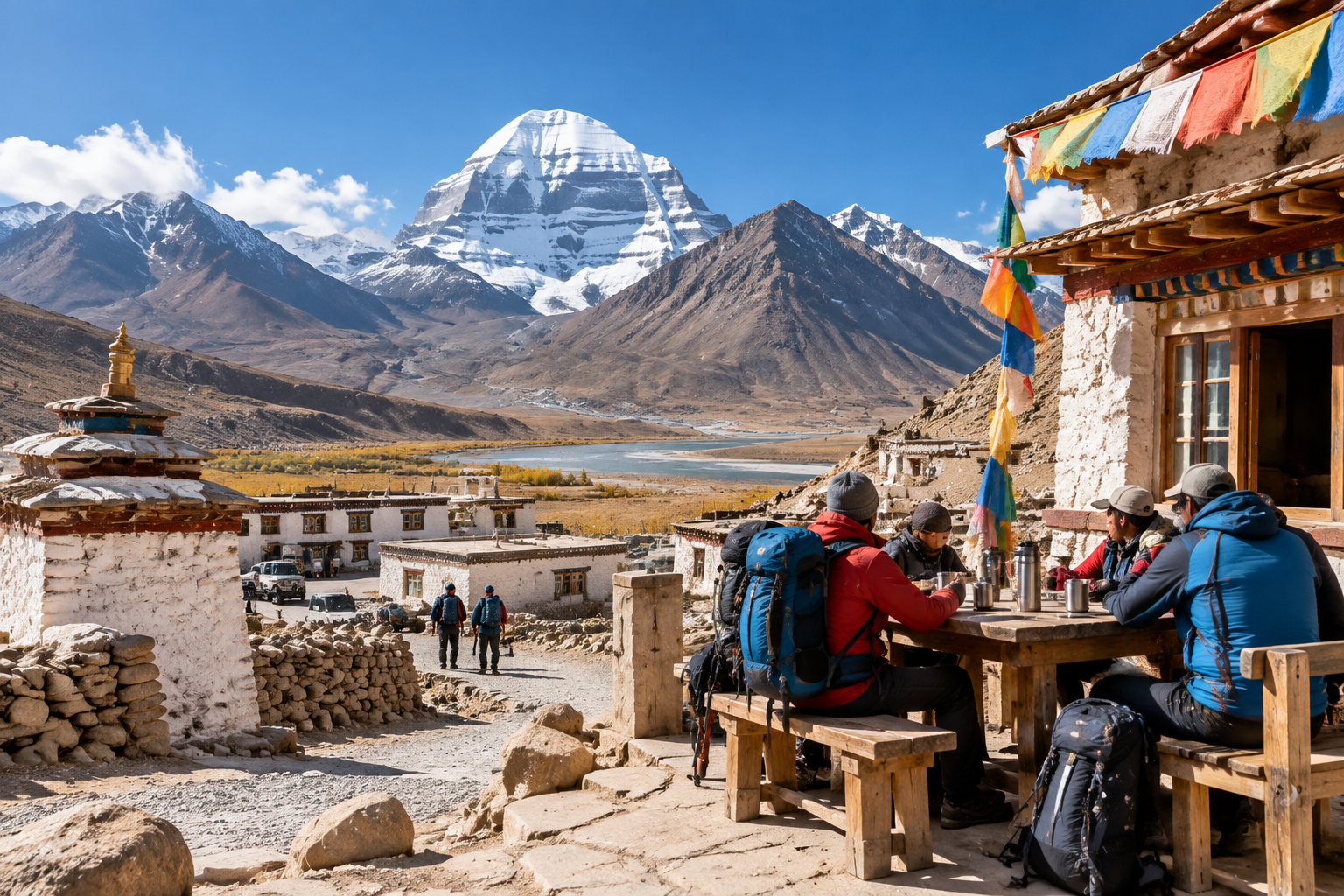
Planning for a 2027 Kailash Mansarovar Yatra begins now, not next spring. For Hindu families across Delhi and the NCR, the pull toward Mount Kailash and the still waters of Mansarovar is rarely a vacation decision — it is a vow, often carried for years before the first inquiry is made. What turns that vow into a boarding pass is paperwork, altitude planning, and a route choice made eighteen months in advance.
Interest in high-altitude Himalayan expeditions has rebounded sharply. According to the Tibet Autonomous Region’s Department of Culture and Tourism, inbound tourism to Tibet increased by 525.6% in Q1 2024, a signal of how quickly regional travel appetite returned. Pressure on seats followed: China capped Indian pilgrims traveling via the Nepal route at 24,000 for the 2024 season, and that ceiling shapes how quickly packages fill.
Against that demand, the single most consequential decision a pilgrim makes is route. The helicopter-based yatra uses air travel to bypass several days of high-altitude trekking, moving pilgrims through Nepalgunj and Simikot to Hilsa before the Tibetan border crossing. The road itinerary takes a slower path. Both reach the same kora — but they ask very different things of the body.
Treat 2027 permit windows as fixed, not flexible. Quota-driven seasons reward pilgrims who commit early and leave documentation to specialists.
Comparing 2027 Delhi-to-Kailash Routes: Helicopter vs. Road
Most Kailash Mansarovar Yatra packages from Delhi resolve into two itinerary families, and the choice between them is medical before it is financial.
The helicopter route (via Nepalgunj–Simikot–Hilsa)
Departs Delhi for Kathmandu or Nepalgunj, then uses fixed-wing and rotor transfers to reach the Tibetan frontier.
Uses air travel to skip several days of high-altitude trekking, moving through Nepalgunj and Simikot to Hilsa.
Compresses the overall journey, which suits pilgrims with limited leave or family members who cannot sustain multi-day walking.
Carries weather risk: Simikot and Hilsa sectors are visual-flight sectors, and fog or cloud can hold a group for a day or more.
The road route (via Kathmandu)
Crosses overland through the Nepal–Tibet border and climbs gradually across the Tibetan plateau.
Allows the body more hours at intermediate elevations, which many pilgrims find easier on the lungs and heart.
Runs longer, with more nights in basic guesthouses and more time on rough mountain highway.
Costs less per head in most seasons, because helicopter hours are the single heaviest line item in any package.
The Simikot-to-Hilsa transfer is the hinge of the entire helicopter itinerary. It is short, weather-dependent, and non-negotiable — operators who build buffer days around it protect your darshan. Those who do not are selling you a schedule, not a pilgrimage.
Breaking Down the Kailash Mansarovar Yatra Cost from Delhi
The Kailash Mansarovar Yatra cost from Delhi is not one number. It is three cost centers stacked on top of each other, and understanding them tells you whether a quote is honest.
Transport
Mode drives price more than anything else. Helicopter sectors between Nepalgunj, Simikot, and Hilsa are charged by flight hour and seat, so a rotor-assisted itinerary sits well above a Kathmandu road package of the same duration. Bus-based groups spread fixed vehicle costs across more passengers, which is why larger road convoys quote lower per person.
Permits
Chinese group visa processing, Tibet travel documentation, and the Kailash area entry clearances are all handled in batch, usually through a Kathmandu-side partner. Because China capped Indian pilgrims via the Nepal route at 24,000 for the 2024 season, quota pressure has carried through into how aggressively operators pre-block permits and seats — and pre-blocked inventory is priced accordingly.
Ground Logistics
This is where quotes diverge most. Yak and porter hire for the Dolma La crossing, oxygen cylinders, pulse oximeters, backup vehicles, insurance with high-altitude evacuation coverage, and satellite communication are either inside your Kailash Mansarovar Yatra package price or waiting for you in cash at 15,000 feet. Ask which.
State Subsidies and Financial Aid for Indian Pilgrims
Several Indian state governments offer financial assistance to residents who complete the Kailash Mansarovar Yatra, and many pilgrims only discover this after returning home. Reimbursement schemes differ by state, but the structure is broadly similar.
Uttar Pradesh operates a pilgrim assistance scheme for domiciled residents who complete the yatra, processed through the state’s religious affairs department.
Gujarat has historically supported yatris through a subsidy mechanism administered by its pilgrimage development authority.
Karnataka likewise provides assistance to resident pilgrims, routed through its state-level religious endowments department.
Other states, including Delhi and several in the north and west, have run comparable schemes in various seasons; eligibility and amounts are revised periodically, so verify current rules with the relevant state department before you travel.
Common eligibility threads run across all of them: proof of domicile, age thresholds, an income or category condition in some states, and — critically — documentary evidence that you actually completed the journey. A yatra completion certificate issued by your tour operator or the organizing authority is almost always mandatory.
Preserve every document from the moment you leave Delhi. Keep your permit copies, border entry stamps, group visa page, boarding passes, hotel vouchers, and the operator-issued completion certificate. Reimbursement claims are rejected on missing paperwork far more often than on eligibility.
The Aerial Darshan Alternative for 2027
Not every pilgrim who feels the call can walk the kora. Age, cardiac history, joint replacement, respiratory limitation, or simple frailty rule out the parikrama for a large number of devotees — and for them the Kailash Aerial Darshan exists.
The Aerial Darshan is a chartered flight experience. Pilgrims board a fixed-wing aircraft, fly along the Himalayan arc, and receive a clear sighting of the Kailash peak and the Mansarovar basin from altitude, typically returning the same day. There is no trek, no overnight at plateau elevation, and no days-long exposure to thin air.
Two structural advantages make it worth considering seriously. First, the physical screening and age ceiling that govern the traditional trek — commonly set at seventy years for the overland and helicopter routes — do not apply in the same way, because the body is never placed under sustained high-altitude load. Second, a flight that does not cross into Chinese territory requires neither a Chinese visa nor a Tibet Travel Permit, removing the longest and least predictable part of the paperwork chain entirely.
For a parent in their late seventies, or a devotee managing a serious cardiac or pulmonary condition, Aerial Darshan is often the only responsible way to complete the Sankalp. The darshan is real; only the exertion is removed.
What to Know Before You Book: The 2027 Checklist
Before you compare Kailash Mansarovar Yatra 2027 packages line by line, test every shortlisted operator against four questions.
Does the operator provide specialized Gujarati, Jain, or satvik catering across the full itinerary? Dietary comfort is not a luxury at altitude. Pilgrims who cannot eat the food available on the plateau lose strength quickly, and a kitchen team traveling with the group is the difference between a sustained appetite and a shortened yatra.
What is the operator’s documented protocol for high-altitude medical emergencies? Ask specifically about oxygen cylinder count per group, pulse oximetry monitoring schedule, the presence of a trained medical escort, and the evacuation chain from the Dolma La side of the kora back to Kathmandu.
Does the quoted price include all permit and visa processing? Chinese group visa fees, Tibet travel documentation, Kailash area permits, and Nepal-side clearances should be itemized inside the package, not collected separately in Kathmandu.
Does the route match your physical capability rather than your budget? A pilgrim who books the cheaper road itinerary to save money, then cannot sustain the gradual climb, has spent more and reached less than one who paid for the helicopter sector.
Answer these four honestly and the shortlist usually narrows to one or two names.
Choosing Your Spiritual Partner for the Journey
The search for the Kailash Mansarovar Yatra best tour operator is really a search for someone who has stood at 18,000 feet with a group that was struggling and knew what to do next. Thirteen years of continuous logistical work in the Himalayan region builds that instinct — knowing which Simikot weather window will hold, which guesthouse in Darchen has reliable heating, how long a Chinese group visa batch actually takes to clear, and when to turn a pilgrim back for their own safety.
Culturally attuned service matters just as much. A traveling kitchen that can produce Jain or Gujarati satvik meals at plateau altitude keeps devotees nourished and dignified. Hindi and Gujarati-speaking escorts remove the isolation that elderly pilgrims feel in an unfamiliar landscape. These are not amenities; they are what allow a seventy-year-old to complete a parikrama with her mind on the mountain rather than on her stomach.
Quotas close early, and 2027 permit allocations will be absorbed by groups that committed well ahead of the season.
Speak to a Kailash specialist at Travel Dukaan now about your 2027 departure. Share your age, medical history, and dietary requirements upfront, and let the route be built around your body — so the journey can belong to your spirit.
Book Kailash Mansarovar Yatra Packages form Delhi at Travel Dukaan now and enjoy the journey without additional concerns!